
If you’ve ever typed something into Google and landed on a page that answered exactly what you needed — that page didn’t get there by accident. Someone made decisions, large and small, that helped Google understand it, trust it, and put it in front of you. That’s SEO.
SEO, or search engine optimization, is the practice of improving a website so that it shows up higher in search results for the things people are actually searching for — without paying for ads. It covers everything from the words on your page, to the code behind it, to how other websites talk about you.
That’s the one-line version. The rest of this guide is the version that actually helps you do something with it — how search engines work under the hood, the different types of SEO, what really moves rankings, the myths that waste people’s time, and how to start applying it, whether you’re running a blog, an e-commerce store, or a service business.
Note: At SeoscaleX, this is the same explanation we give new clients before we touch a single keyword.
Why SEO Actually Matters
Search is still where most buying decisions start. Long before someone fills out a contact form or adds something to a cart, they’re usually typing a question into a search engine — “best [product] for [use case],” “how does [service] work,” “[problem] fix.” If your website doesn’t show up for those searches, a competitor’s does.
A few reasons SEO earns its place in a marketing budget:
- It’s compounding, not rented. Paid ads stop the moment you stop paying. A well-optimized page can keep bringing in traffic for years off a single round of work.
- It captures intent, not interruption. People searching are already looking for what you offer. You’re not convincing a stranger to care — you’re answering someone who already does.
- It builds trust by default. Most people still trust organic results more than ads, even if they can’t articulate why. Ranking well is a credibility signal in itself.
- It’s measurable. Rankings, organic traffic, click-through rate, and conversions from search are all trackable, which makes SEO one of the more accountable channels in marketing.
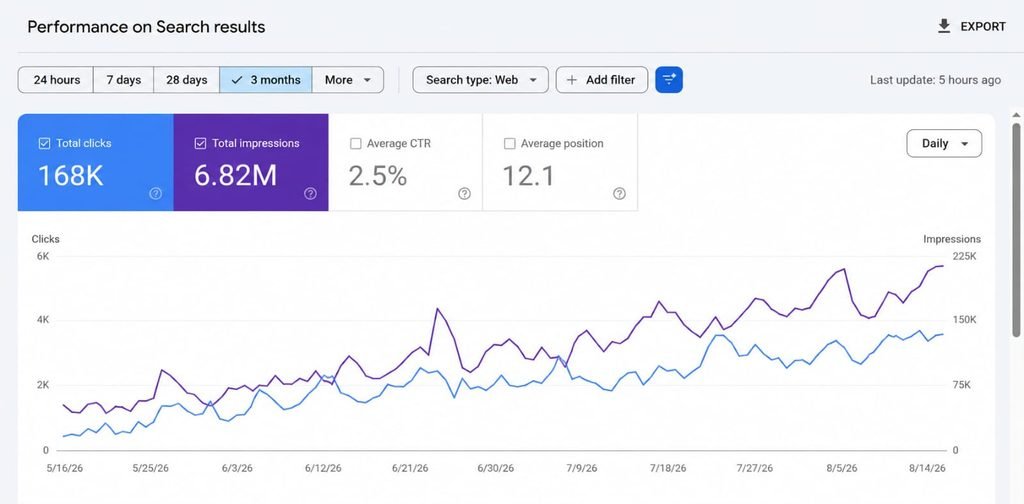
One of our clients, had around 2,000 organic clicks when they came to us and in just 6 months we took it to around 7,500 clicks, a growth of 275%.
How Search Engines Actually Work
To understand SEO, it helps to understand what a search engine is doing behind the scenes every time someone searches. There are three stages: crawling, indexing, and ranking.
1. Crawling
Search engines use automated programs — Google’s is called Googlebot — that constantly move across the web, following links from page to page, discovering new and updated content. If a page has no links pointing to it and isn’t submitted anywhere, it can be genuinely invisible to a crawler, no matter how good the content is.
2. Indexing
Once a page is crawled, the search engine tries to understand what it’s about — the topic, the format, the language, whether it’s a duplicate of something else — and stores it in a massive database called the index. A page has to be indexed before it can ever appear in results. Not every crawled page makes it into the index; thin, duplicate, or blocked content often doesn’t.
3. Ranking
When someone searches, the engine doesn’t search the live web in real time — it searches its index and ranks the most relevant, trustworthy pages for that specific query. This is where hundreds of signals come into play: relevance to the search term, content quality, site usability, page speed, mobile-friendliness, and the site’s overall authority, among others.
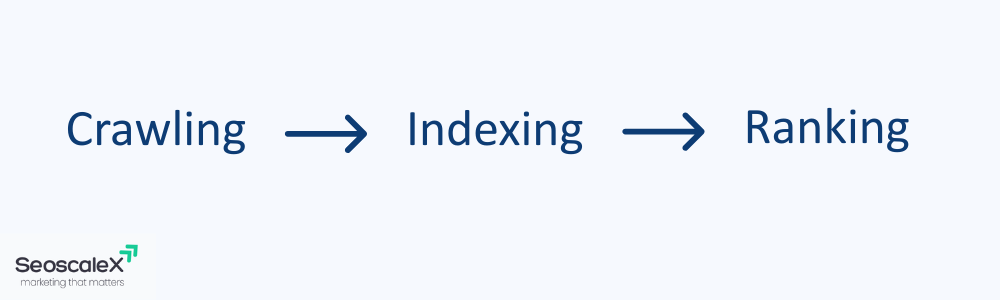
The practical takeaway: if a page can’t be crawled, it can’t be indexed. If it can’t be indexed, it can never rank — no matter how well-written it is. This is why technical SEO comes before content polish in most real audits.
The Main Types of SEO
“SEO” isn’t one activity — it’s an umbrella term for several disciplines that work together. Most comprehensive strategies touch all of these:
On-Page SEO
Everything you control directly on a given page: the title tag, headings, body content, internal links, image alt text, and URL structure. This is where keyword research turns into actual content — making sure a page clearly signals what it’s about, to both users and search engines.
Technical SEO
The behind-the-scenes health of a website: crawlability, site speed, mobile responsiveness, secure connections (HTTPS), structured data (schema markup), XML sitemaps, and clean site architecture. A site can have brilliant content and still fail to rank if technical issues block search engines from properly accessing or understanding it.
Off-Page SEO
Signals that happen away from your own site — most commonly backlinks (other sites linking to yours), brand mentions, and to a growing extent, presence and citations across the web (directories, review sites, social profiles). This is traditionally treated as the hardest lever to pull, since it depends on other people choosing to reference you.
Content SEO
Sometimes bundled into on-page SEO, but worth calling out separately: this is about depth, originality, and actually answering the search intent behind a query — not just placing keywords. Search engines have gotten very good at telling the difference between content written to rank and content written to genuinely help someone.
Local SEO
For businesses that serve a specific area — a clinic, a restaurant, a service provider — local SEO focuses on Google Business Profile optimization, local citations, reviews, and location-specific content, so the business shows up in “near me” and map-pack results.
What Actually Influences Google Rankings
Google has confirmed it uses hundreds of ranking signals, and doesn’t publish the full list or their exact weighting. That said, based on Google’s own public documentation and years of observable testing across the industry, a few categories consistently matter:
- Relevance — how directly the content answers the specific search query, not just the general topic
- Content quality and depth — whether the page covers the topic thoroughly and accurately, in a way that’s genuinely useful
- Experience, Expertise, Authoritativeness, Trustworthiness (E-E-A-T) — covered in detail below
- Page experience — load speed, mobile usability, and avoiding intrusive interstitials
- Crawlability and indexability — whether search engines can actually access and understand the page
- Backlinks and authority signals — though their relative weight has shifted over the years as content-quality signals have matured
- User engagement signals — indirect evidence like whether people click a result and actually stay, though Google has been cautious about how directly these feed ranking
There is no single factor that guarantees a top ranking on its own. Pages tend to rank well when several of these line up at once — which is really the whole point of doing SEO properly instead of chasing one tactic.
On-Page SEO: The Checklist That Actually Matters
This is the part most beginner guides oversimplify into “use your keyword a few times.” In practice, on-page SEO is closer to this:
- Title tag — includes the primary keyword naturally, stays under ~60 characters, and is written to earn a click, not just describe the page
- Meta description — a genuine, specific summary (150–160 characters) that gives someone a reason to click, even though it isn’t a direct ranking factor itself
- URL structure — short, readable, and includes the target keyword where it fits naturally
- Headings (H1, H2, H3) — one clear H1, with H2s and H3s that logically break the topic into subtopics — this also happens to be what makes content scannable for readers
- First 100 words — the primary keyword and the core answer to the query should appear early, both for readers skimming and for search engines confirming relevance
- Internal linking — links to other genuinely related pages on the site, using descriptive (not “click here”) anchor text
- Image optimization — compressed file sizes, descriptive file names, and alt text that describes the image (which also matters for accessibility)
- Content depth — covering the subtopics a reader would reasonably expect, based on what’s actually being searched around this topic — not padding for word count
Technical SEO Essentials
A quick, non-exhaustive list of what “technical SEO” covers in practice:
- Site speed — Core Web Vitals (loading, interactivity, visual stability) affect both rankings and how many visitors actually stick around
- Mobile-friendliness — Google indexes the mobile version of a site by default (mobile-first indexing), so a poor mobile experience directly affects rankings, not just usability
- HTTPS — a baseline trust and security signal at this point, not optional
- XML sitemap and robots.txt — help search engines understand what to crawl and what to skip
- Structured data (schema markup) — code that helps search engines understand content type (article, FAQ, product, review) and can unlock rich results like star ratings or FAQ dropdowns in search
- Canonical tags — prevent duplicate content issues when the same content is accessible via multiple URLs
- Clean site architecture — a logical structure so both users and crawlers can find any page within a few clicks
Off-Page SEO and Backlinks
Off-page SEO is largely about earning signals of trust from outside your own website — the most well-known being backlinks. When a reputable website links to yours, it acts as a vote of confidence in the eyes of search engines.
That said, backlinks aren’t the only lever, and chasing them isn’t always the fastest or safest path — low-quality or manipulative link-building can do more harm than good. Other off-page signals that matter:
- Brand mentions, even without a link
- Reviews and ratings across the web
- Social signals and shares (indirect, but they influence visibility and, sometimes, links)
- Digital PR and genuine media coverage
A well-built page can also earn rankings through strong on-page depth, technical soundness, and topical relevance alone — especially for less competitive queries — before backlinks come into the picture at all. That’s a realistic goal for a single page; for highly competitive, high-volume terms, backlinks still tend to matter more over time.
E-E-A-T: Why Google Cares Who Wrote This
E-E-A-T stands for Experience, Expertise, Authoritativeness, and Trustworthiness. It comes from Google’s Search Quality Rater Guidelines — the document Google gives human quality raters to evaluate search results, which in turn shapes what Google’s systems are trained to reward.
A quick, important clarification: Google has stated that E-E-A-T itself isn’t a direct ranking factor you can “turn on” — it’s a framework, reflected through other signals like content quality, author credibility, citations, and site reputation. In practice, though, pages that clearly demonstrate real experience and expertise tend to perform better, especially for topics where trust genuinely matters — health, finance, and yes, advice that affects someone’s business, like SEO itself.
What this looks like in practice for a page like this one:
- A named author with real, checkable credentials
- First-hand examples and specifics, not just recycled definitions
- Citations to primary, authoritative sources (Google’s own documentation, not just other blogs quoting each other)
- Clear ownership — an “About” page, real contact information, and a company behind the content
- Content that’s kept current as the topic evolves
Keyword Research, Briefly
Keyword research is the process of figuring out what your audience is actually typing into search engines, and how much competition exists for those terms. At a basic level, it involves:
- Identifying seed topics relevant to your business
- Expanding those into specific queries and phrases people actually search (using tools like Google Keyword Planner, Ahrefs, Semrush, or even Google’s own autocomplete and “People also ask” boxes)
- Understanding search intent — is someone looking to learn something (informational), compare options (commercial), or buy right now (transactional)?
- Prioritizing keywords by a mix of search volume, competition, and relevance to what the business actually offers
Good keyword research shapes not just which words appear on a page, but what the page is even about in the first place — it should come before writing, not after.
SEO vs. SEM vs. PPC — What’s the Difference?
These terms get used interchangeably, but they’re not the same thing:
| Term | What it means |
|---|---|
| SEO | Improving organic (unpaid) rankings through content, technical work, and authority-building |
| SEM | Search Engine Marketing — the umbrella term that includes both SEO and paid search |
| PPC | Pay-Per-Click — paid ads (like Google Ads) where you pay for each click, and visibility stops when the budget does |
SEO and PPC aren’t competitors so much as different timelines: PPC can drive traffic immediately but stops when you stop paying; SEO takes longer to build but tends to keep delivering traffic well after the initial work is done. Most serious marketing strategies use both, at different stages.
Common SEO Myths, Debunked
A few outdated ideas still circulate widely, some of which Google has directly addressed:
- “Meta keywords help rankings.” Google has confirmed it doesn’t use the meta keywords tag at all.
- “More content is always better.” Content length alone isn’t a ranking factor. A page that fully answers the query in 800 words can outrank a padded 3,000-word page.
- “Keyword stuffing works.” Repeating a keyword unnaturally is against most search engines’ spam policies and actively hurts readability — and rankings.
- “You need a keyword in your domain name.” It has little to no direct ranking effect beyond minor visibility in breadcrumbs.
- “E-E-A-T is a direct ranking factor.” As covered above, it isn’t literally one — it’s a quality framework reflected through other signals.
- “SEO is a one-time project.” Search engines update constantly, competitors keep publishing, and content ages. SEO is closer to ongoing maintenance than a one-off task.
How AI Search Is Changing SEO
Search itself is shifting. AI-generated overviews and answers now appear directly in search results for many queries, sometimes reducing the need for someone to click through to a website at all. This doesn’t make SEO irrelevant — if anything, it raises the bar: content still needs to be crawlable, well-structured, and clearly authoritative to be pulled into AI-generated answers or cited as a source within them.
Practical implications for how content should be built going forward:
- Clear, direct answers near the top of a page (AI summarization tools favor content that’s easy to extract)
- Structured data and clean formatting, which make content easier for both traditional crawlers and AI systems to parse
- Genuine expertise and originality, since AI-generated answers increasingly pull from — and cite — sources seen as authoritative on a topic
How to Measure SEO Success
SEO isn’t just “did we rank #1.” A more complete view of performance usually includes:
- Organic traffic — visits arriving through unpaid search results
- Keyword rankings — position tracking for target terms over time
- Click-through rate (CTR) — how often people click your result when they see it
- Organic conversions — leads, sign-ups, or sales that originate from organic search
- Domain authority / rating — a third-party estimate (from tools like Moz or Ahrefs) of a site’s overall SEO strength
- Core Web Vitals — technical performance metrics tied to user experience
Like this
How Long Does SEO Take?
Realistically: meaningful movement often starts showing in 3 to 6 months, with more substantial results building over 6 to 12 months, depending on the competitiveness of the industry, the current state of the site, and how consistently the work is done. Google itself advises waiting at least a few weeks to assess any single change, and cautions against expecting instant results.
This is one of the most searched follow-up questions after “what is SEO,” so it earns its own heading here rather than a passing mention — and it’s worth answering honestly rather than optimistically, since overpromising timelines is one of the fastest ways agencies lose client trust.
Getting Started: A Basic SEO Roadmap
For someone starting from zero, roughly in order:
- Set up tracking — Google Search Console and Google Analytics, at minimum
- Fix technical basics — make sure the site is crawlable, mobile-friendly, and reasonably fast
- Do keyword research — understand what your audience actually searches for
- Audit or create core content — build pages that genuinely answer the target queries in depth
- Optimize on-page elements — titles, headings, internal links, alt text
- Build authority over time — through genuinely useful content, digital PR, and where relevant, backlinks
- Monitor and iterate — SEO is not “set and forget”; rankings shift, and content needs revisiting
Not sure where to start? SeoscaleX offers a free SEO audit!
Frequently Asked Questions
What does SEO stand for?
SEO stands for Search Engine Optimization — the practice of improving a website to rank higher in unpaid search results.
Is SEO free?
The traffic SEO earns is unpaid, but the work behind it — content creation, technical fixes, tools, and often specialist time — isn’t free. It’s usually described as a “free traffic, paid effort” channel.
Can I do SEO myself, or do I need an agency?
Basic SEO is learnable and many small businesses start there. Agencies or specialists tend to add the most value with technical depth, competitive strategy, and time savings as a site or business grows more complex.
Does SEO still matter with AI search on the rise?
Yes — arguably more, not less. AI-generated answers still need to source information from somewhere, and being cited as that source depends on the same fundamentals: crawlable, authoritative, well-structured content.
Leave a Reply