
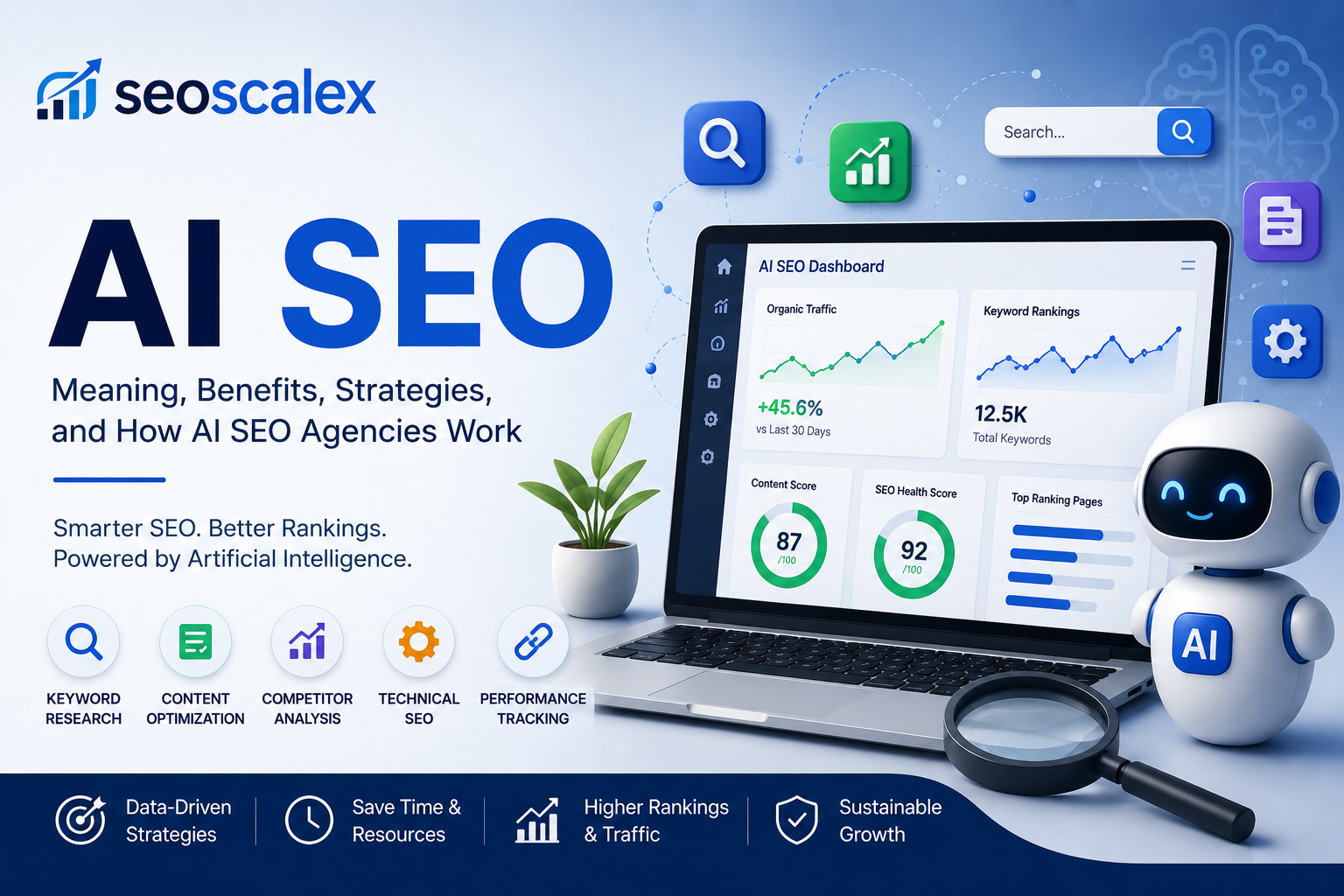
AI SEO (Artificial Intelligence Search Engine Optimization) is the process of using machine learning algorithms, natural language processing (NLP), and large language models (LLMs) to enhance keyword discovery, technical site auditing, automated workflows, and content relevance. It optimizes digital properties to rank simultaneously in traditional search results and AI-driven answer engines.
Understanding the true AI SEO meaning requires moving past basic automated text generation. Modern AI-powered SEO utilizes algorithmic intelligence across the entire search lifecycle: identifying high-value entity connections, predicting search intent trends, automating crawl error remediation, and aligning website structure with conversational discovery algorithms. Implementing an intentional AI SEO strategy allows marketing teams to scale manual workflows, though human editorial oversight remains critical to prevent factual hallucination and maintain search quality standards.
What Is the Difference Between AI SEO and Traditional SEO?
While traditional optimization focuses on static keyword placement and manual site inspections, SEO with AI adapts dynamically to semantic shifts, entity graphs, and search engine algorithms.
| Optimization Layer | Traditional SEO Framework | AI-Powered SEO Framework |
| Keyword Research | Exact-match query discovery, static volume metrics, manual grouping | Vector-based semantic grouping, predictive intent modeling, entity gap analysis |
| Content Production | Manual drafting, isolated keyword density scoring | NLP-guided topical depth, automated contextual briefs, real-time citation matching |
| Technical Crawling | Periodic site scans, manual log analysis | Continuous predictive crawl path modeling, automated schema generation |
| Search Target | Top 10 organic blue links on SERP | Simultaneous visibility across organic SERP, Google AI Overviews, and conversational engines |
From SEO to GEO: Optimizing for LLMs, ChatGPT, and AI Overviews
The search landscape has shifted from direct link retrieval to synthesized answers, making AI search optimization a core discipline. Generative Engine Optimization (GEO) focuses on positioning brand entities and proprietary data directly inside LLM training sets, real-time retrieval-augmented generation (RAG) feeds, and generative summaries.
Key GEO Optimization Priorities
- Information Gain & Original Data: LLMs deprioritize generic summary content lacking original data. Provide unique industry statistics, original case studies, and distinct viewpoints to trigger inclusion in answer summaries.
- Schema-Structured Knowledge: Wrap product specifications, author credentials, and processes in robust JSON-LD schema to make data extraction frictionless for search models.
- Direct Definition Formats: Present concepts using explicit subject-predicate structures within the opening 50 words of each section to capture rapid AI Overview citation slots.
Core Benefits of AI SEO for Modern Brands
Understanding the practical benefits of AI SEO helps organizations allocate technical resources effectively without falling for industry hype. Applying AI for SEO delivers measurable operational efficiencies alongside distinct algorithmic advantages:
- Accelerated Research & Execution: Compress multi-week topical cluster mapping into hours while evaluating large-scale SERP features in real time.
- Enhanced Semantic Depth: Pinpoint latent semantic gaps and entity relationships that manual audits often miss, improving comprehensive topical authority.
- Precision Technical Auditing: Uncover log anomalies, duplicate intent cannibalization, and render-blocking resources before they hurt indexing performance.
- Predictive Search Intent Mapping: Forecast seasonal search pattern changes and topic demand shifts to publish content ahead of peak search volumes.
- Balanced Operational Trade-offs: While these AI SEO benefits significantly reduce manual analysis time, organizations must pair automation with human domain experts to verify technical outputs and maintain E-E-A-T guidelines.
The 5-Stage AI SEO Optimization Strategy
Executing a high-performing search program requires a structured workflow balancing automation with human editorial control.
| Stage | Focus Area | Key Actions & Workflows | Strategic Objective |
| Stage 1 | Semantic Entity & Intent Extraction | Map primary topics to Google Knowledge Graph entities; run vector clustering; identify NLP topical gaps against top-ranking competitors. | Establish comprehensive topical authority and align content with conversational search intent. |
| Stage 2 | Algorithmic Content Architecture | Build modular answer structures, explicit definition hooks within the first 50 words, and comparative data tables. | Optimize layout for instant parsing by SERP featured snippets and AI answer engines. |
| Stage 3 | Automated Technical Infrastructure | Deploy dynamic JSON-LD structured data; run automated server-side rendering checks; resolve Core Web Vitals bottlenecks. | Maximize crawl efficiency and eliminate render-blocking resources at scale. |
| Stage 4 | Generative Optimization (GEO) | Seed unique data points, proprietary studies, and expert commentary for RAG feeds and conversational LLMs. | Secure authoritative citations in Google AI Overviews, ChatGPT, and Perplexity responses. |
| Stage 5 | Continuous SERP & Log Adaptation | Track automated query drift, monitor URL decay, and analyze log files for crawl anomalies. | Proactively update underperforming sections before organic traffic drops. |
- Semantic Entity & Intent Extraction: Map primary topics to Google Knowledge Graph entities. Use NLP tools to discover semantic gaps and topical associations missing from top competitors.
- Algorithmic Content Architecture: Build pages with modular answer structures, explicit definition hooks, and data tables for instant snippet parsing.
- Automated Technical Infrastructure: Deploy dynamic JSON-LD markup and automated server-side rendering checks to maintain optimal crawl efficiency and strong Core Web Vitals.
- Generative Optimization (GEO): Seed distinct data points, proprietary studies, and expert quotes to earn consistent citations inside ChatGPT, Perplexity, and Google AI Overviews.
- Continuous SERP & Log Adaptation: Monitor query drift and decaying URLs using automated rank and crawl tracking, updating low-performing sections before traffic drops.
How AI SEO Agencies Work: Human Expertise Meets Algorithmic Scale
A specialized AI SEO agency does not simply run automated content generation tools; instead, it combines proprietary predictive software with senior editorial governance. Modern agencies bridge the gap between automated data processing and manual quality validation through three primary operational pillars:
- Algorithmic Gap Auditing: Agencies utilize enterprise machine learning platforms to perform vector embeddings on client content, benchmarking entity coverage against top ranking clusters and knowledge graph repositories.
- Editorial & E-E-A-T Governance: To protect sites from search quality penalties, experienced editors verify all programmatic outputs, conduct original primary research, and ensure content provides tangible information gain.
- Continuous GEO Pipeline Engineering: Agencies structure technical digital assets specifically to feed Retrieval-Augmented Generation (RAG) pipelines, securing recurring brand mentions across conversational engines.
Evaluating Modern AI SEO Tools: Manual vs. AI Stack
Selecting the right AI SEO tools depends on your technical maturity, team size, and target search index.
| Tool Category | Leading AI Tools | Primary Function | Advantage Over Manual Methods |
| NLP Content Optimization | Surfer SEO, Clearscope, Frase | Semantic density, entity matching, and contextual scoring | Real-time SERP NLP benchmarking vs. subjective drafting |
| Technical & Crawl Automation | Screaming Frog (AI features), Botify | Automated log file interpretation and predictive crawl anomaly detection | Instant detection of multi-million page indexation issues |
| Search Intent & Clustering | Keyword Insights, MarketMuse | Vector-based semantic grouping and cannibalization alerts | Groups 10,000+ keywords by intent within minutes |
| Generative Discovery & GEO | Semrush AI, BrightEdge | Brand citation tracking across LLM responses and Google Overviews | Monitors multi-platform conversational engine visibility |
Frequently Asked Questions
What is AI SEO? It is an advanced search marketing framework that uses machine learning, natural language processing, and automated data modeling to streamline keyword research, content optimization, and technical performance. It analyzes search intent patterns at scale to optimize content for both traditional SERP links and generative AI engines.
No. While AI-powered SEO automates repetitive data parsing and basic drafting, human strategists remain mandatory for strategic oversight, original qualitative analysis, brand governance, and ensuring adherence to search engine quality raters guidelines.
The primary benefits are faster campaign execution, deeper semantic content quality, real-time technical error detection, and better visibility across generative engines like Google AI Overviews and ChatGPT.
Identify your primary operational bottleneck: use tools like Surfer SEO or Clearscope for content and NLP scoring, Botify or Screaming Frog for technical scale, and Keyword Insights for vector keyword clustering.
Leave a Reply